// Affiliate disclosure: some of the links in this post are affiliate links, which means we may earn a small commission if you buy through one, at no extra cost to you. And if you do, that money goes straight to our knife problem (or beer money, let's be honest).
The Short Answer
What Is a Kitchen Knife Bevel?
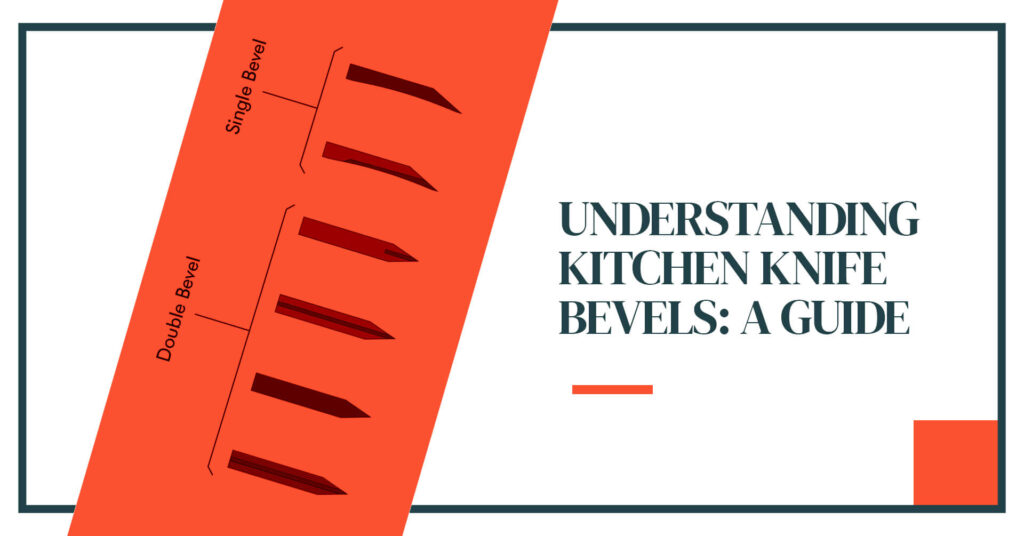
A kitchen knife bevel is the ground, angled surface along the blade that narrows the steel down to the cutting edge. Most kitchen knives are double bevel, ground on both sides; single-bevel knives are ground on just one. That angle is what forms the edge and decides how it slices.
Key Takeaways
- What a bevel is: the ground surface that tapers the blade down to the actual cutting edge. No bevel, no edge.
- Single vs double in one line: a double bevel is ground on both sides and cuts straight; a single bevel is ground on one side and steers.
- The angle rule of thumb: Japanese knives sit around 15° per side, Western-style knives around 20°, a cleaver around 25°. Lower is sharper; higher is tougher.
- The one most people confuse: the primary bevel (the big grind) is not the edge angle (the tiny bevel you actually sharpen). They are two different angles.
- The verdict: almost every knife in your kitchen is a double bevel, and for almost everyone that is the right answer. Stop overthinking it.
The first time it happened, I was sure the knife was defective. I’d flipped a secondhand Japanese blade over to wipe it and noticed one side was ground dead flat — flat like the back of a woodworking chisel — while the other side sloped down to the edge. Someone, I decided, had fallen asleep halfway through sharpening it.
They hadn’t. That was a single bevel, doing exactly what it was built to do. I just didn’t have the words yet.
That flip-the-knife-over moment is where nearly every bevel question starts, and the internet is not much help once you get there. The top result for this exact search is a forum thread literally titled “so confused about bevel and edge angles,” which is the whole problem in one sentence. People blur two things that are not the same: the way a blade is ground and the angle you sharpen it to. Untangle those two and the rest is easy. That’s the job here — plus which bevel actually earns a spot on your board, and how to tell what you’re already holding.
Single Bevel vs Double Bevel
This is the split that matters most, so let’s do it properly. Understanding single and double bevel construction is really understanding one question: how many sides of the blade are ground down to meet at the edge?
A double bevel is ground on both sides, roughly symmetrically, so the two angled faces meet in the middle at the cutting edge — picture a shallow letter V. This is the standard for basically every Western knife and most Japanese ones too: your chef knife, your santoku, the everyday gyuto. It cuts in a straight line because the geometry is balanced, it’s forgiving to sharpen, and it doesn’t care which hand you hold it in.
A single bevel is ground on one side only. The front face is a long, flat grind down to the edge; the back is left nearly flat, often with a slightly concave hollow (the Japanese call it the urasuki). A single-bevel knife is a specialist’s build — a traditional Japanese knife for precise cuts, the kind you’ll see behind a sushi counter. Because the grind is asymmetrical, the blade actively steers as it cuts, which is a feature if you know how to use it and a nuisance if you don’t. It’s also handed: a right-handed single bevel is genuinely awkward in a left hand.
| Single bevel | Double bevel | |
|---|---|---|
| Construction | Ground on one side of the blade; flat or concave back | Ground on both sides, roughly symmetrically |
| How it cuts | Steers and curves — pushes food away from the flat face | Cuts straight; balanced left and right |
| Typical angle | ~10–17° on the single ground side | ~15–20° per side |
| Sharpening | Harder — you maintain the flat back and the bevel; a real learning curve | Easier — even a cheap sharpener or a whetstone gets you there |
| Best for | Thin, precise work: sashimi, katsuramuki, single-purpose prep | Everything else — the daily driver |
| Example knives | Deba, usuba, yanagiba (traditional Japanese) | Gyuto, santoku, Western chef knife |
The short version: a single bevel is a scalpel with opinions. A double bevel is a good all-rounder that just works. If you want the deeper cut on the traditional single-bevel vegetable knives, the nakiri and usuba comparison gets into the deba-and-usuba family, and the yanagiba versus sujihiki piece covers the single-bevel slicer built for fish.
Bevel Angle vs Edge Angle — the Part Everyone Confuses
Here’s the disambiguation nobody selling knives bothers to make, and it’s the reason that Reddit thread exists.
There are two bevels on most knives, not one.
The primary bevel — also called the grind — is the big taper. It’s the whole angled surface that thins the thick spine down toward the edge over the width of the blade. It’s mostly about blade geometry: how the knife wedges through a carrot, how it falls through a tomato.
The edge angle — the secondary bevel — is the tiny bevel right at the very tip of the edge. It’s a few millimeters at most, and it’s the only part you touch when you sharpen. When someone says their knife is “a 15-degree knife,” they mean this secondary edge angle, not the primary grind.
Miss the distinction and you get the classic confusion: someone reads that Japanese knives are “15 degrees,” tries to lay the whole side of the blade flat on a stone, and grinds away half the blade face. The stone should only ever kiss the secondary bevel.
The primary bevel is how the blade is ground — you basically never touch it. The edge angle is the little secondary bevel at the very edge — that’s the one you sharpen. When what’s on paper gives you a number, it’s talking about the edge angle.
📸 PHOTO 2 — REPLACE WITH IMAGE
Macro of one edge with a hand-drawn overlay marking the primary bevel/grind versus the small secondary edge bevel — the disambiguation diagram.
ALT: Macro of a kitchen knife edge labeling the primary bevel versus the secondary edge angle
What Angle Should Your Knife Be?
Now that we’ve separated the grind from the edge, the angle question actually has clean answers. These are per-side numbers for a double-bevel knife — the angle of one bevel, measured from the flat.
| Knife style | Edge angle (per side) | Why |
|---|---|---|
| Japanese (gyuto, santoku) | ~15° | Harder steel holds a low, keen angle without rolling — sharper, cleaner slices |
| Western (German chef knife) | ~20° | Softer steel wants a wider, tougher edge that resists chipping |
| Cleaver / heavy chopper | ~25° | Blunt, durable geometry for bone, squash, and impact work |
One catch that trips people up: makers report angles in two ways. A “15° knife” usually means 15° per side, which is 30° total (inclusive). Some brands quote the inclusive number instead. Same edge, different math — check which one you’re reading before you set up a sharpener, because getting it wrong doubles or halves your target. Different steel types genuinely want different angles, so don’t chase the lowest number you saw online just because it sounds impressive.
How to Tell What You Already Own
Two questions cover almost everyone: is my knife single or double bevel, and what edge angle is it? You can answer both at the counter, no gadgets required.
Is it single or double bevel? 1. Hold the knife edge-up and look straight down at the cutting edge under good light. 2. Check both faces. If both sides slope symmetrically down to the edge, it’s a double bevel — that’s the overwhelming majority of kitchen knives. 3. Flip it over and look at the back. If one side of the blade is ground flat (or slightly concave) and does the cutting all from the other face, you’ve got a single bevel. Almost anything sold as a “chef knife,” gyuto, or santoku is a double bevel knife.
What angle is my edge? (the marker test) 1. Color the very edge of the blade with a permanent marker, right along the bevel. 2. Set the knife on a whetstone or sharpener at the angle you think it should be and draw it across once — no pressure, one light pass. 3. Look at the ink. If it wiped off the whole secondary bevel evenly, your angle matches the factory grind. If it only rubbed off the top (the shoulder) or the very tip, you’re too high or too low — adjust and try again until the marker clears in one pass.
📸 PHOTO 3 — REPLACE WITH IMAGE
The marker test in progress — edge colored with a permanent marker, being drawn once across a whetstone, showing where the ink wipes off to reveal the actual sharpening angle.
ALT: Marker test on a whetstone revealing a kitchen knife’s true edge bevel angle
The marker test is the single most useful trick in this whole article. It turns “I hope I’m holding the right angle” into “I can see the angle.” Do it once and you’ll never guess again.
Western vs Japanese Bevels
The bevel a knife wears isn’t a style choice — it follows the steel. This is where blade geometry and metallurgy shake hands.
A traditional Japanese knife is usually made from harder steel. Hard steel can hold a lower, keener angle without the edge rolling over, which is why so many Japanese double bevels sit around 15° per side and feel almost unfairly sharp out of the box. The trade-off: hard steel is more brittle, so that thin edge chips if you push it through frozen food, bone, or a hard squash.
Western-style knives lean on softer, tougher steel. It won’t take quite as keen an angle, but it bends instead of chips, so a wider ~20° edge holds up to a home cook who occasionally hits a plate or a chicken bone. It’s the difference between a race tire and an all-season: one is sharper on paper, the other survives your actual driving. Neither is “better.” The right bevel is the one that matches how hard the steel is and how carefully you cook.
Which Bevel Belongs on Your Board
Let me save you the suspense: for almost everyone, the answer is a double bevel. If you’re reading this trying to decide, you want a double-bevel knife. Full stop.
Here’s why that’s not a cop-out. A double bevel cuts straight, sharpens easily, works in either hand, and handles every job a home kitchen throws at it. A single bevel is a genuinely brilliant tool for one narrow set of tasks — paper-thin, precise cuts where the steering is the whole point — and a mild inconvenience for everything else. Unless you’re breaking down whole fish for sashimi or you specifically want to learn traditional technique, the single bevel is a knife you’ll admire and then not reach for.
Double bevel — the case for: – Cuts straight; no learning the steer – Forgiving to sharpen with any whetstone or sharpener – Works left- or right-handed – Does 100% of normal home prep
Single bevel — the honest trade-offs: – Unbeatable at thin, precise, single-direction cuts – Steers and curves in ways a double bevel can’t – Handed, harder to sharpen, and a real time investment – Overkill — and often frustrating — for everyday cooking
Go single bevel if: – You’re prepping sushi, sashimi, or doing traditional Japanese vegetable work – You want to learn the craft and enjoy the sharpening ritual – You already own a solid double-bevel workhorse and want a specialist
Stick with double bevel if: – This is your everyday knife, or your first good one – You want to sharpen it without a weekend course – You cook normal food in a normal kitchen (this is most of us)
If the geometry has you spiraling, breathe: you almost certainly want a double bevel, and you almost certainly already own one. For the double-bevel workhorses themselves, the everyday chef knife guide and how a santoku’s bevel compares to a Western chef knife both build straight on this.
Keeping a Bevel Sharp
Whatever bevel you’ve got, the rule is the same, and it’s boring: consistency beats keenness. A blade held at one steady angle every time will out-cut a blade you sharpened razor-thin once and then wrecked with a wobble.
A honing rod (the “steel” in your block) doesn’t sharpen — it straightens an edge that’s rolled over slightly during use. Do it often; it takes ten seconds. A whetstone actually removes metal and resets the edge angle; do that occasionally, when honing stops bringing the edge back. Match the factory angle — that’s what the marker test is for — and don’t get greedy.
Don’t over-thin a Western edge. It’s tempting to chase a Japanese-style 15° on a softer German knife because sharper sounds better. It isn’t, for that steel. Take a tough edge too thin and it rolls or chips instead of lasting. The durable, slightly wider edge wins the week.
You don’t need a drawer of gear to keep a good bevel. A single medium-grit whetstone and a honing rod cover almost every home cook — skip the fancy multi-stone kits until you actually know you want them. (The stone I keep on the bench is linked below; full disclosure, that’s an affiliate link.)
📸 PHOTO 4 — REPLACE WITH IMAGE
Michael honing a double-bevel chef knife on a steel at a consistent angle on his own board — real kitchen, real use.
ALT: Honing a double-bevel chef knife at a steady angle on a kitchen steel
HANDS-ON
On the Board — What It’s Actually Like
Enough theory. Here’s the lived version — what the two bevels are like once they’re in your hand on a Tuesday night, not in a diagram.
I kept a single-bevel deba on the strip for a month next to my double-bevel gyuto, trying to give it a fair shot at everyday prep. It never won. Every time I reached for it to cut something ordinary — an onion, a bell pepper — I’d feel the blade curve away from the flat back and drift off my line, so I’d correct, and correct again, and eventually just pick up the gyuto because the gyuto goes where I point it. The deba is stunning on a fillet. For a weeknight, it’s the wrong animal, and my hand figured that out before my head did.
I once talked myself into thinning a softer Western chef knife down toward a Japanese angle because keener sounded like a free upgrade. It lasted about three days. By the weekend the edge had rolled in two spots and picked up a small chip near the heel, probably off a squash. I put it back to a wider, more normal angle and it held sharp through a full week of actual cooking without complaint. Durability beat keenness, and I stopped chasing the lowest number on the internet.
The marker test embarrassed me the first time I did it in my own kitchen. I’d been sharpening a knife for two years at what I assumed was the factory angle. Colored the edge, took one pass on the stone, and the ink only wiped off the shoulder — I’d been riding way too high the whole time, rounding the edge instead of sharpening it. One dyed edge and a single stroke showed me more than any YouTube video had. Now I marker-test any knife before I sharpen it.
The Final Cut
Knowing your bevel changes two things going forward, and both save you money. First, you’ll read the specs properly — when the next knife brags about a “15-degree edge,” you’ll know that’s the secondary edge angle, not the grind, and you’ll know whether the steel can actually hold it. Second, you’ll stop buying knives to solve problems your double bevel already handles. That single-bevel yanagiba is gorgeous. Unless you’re slicing fish for a living, it’ll live in the drawer.
Flip your knife over. Look at the edge. Whatever’s staring back — flat-backed single or symmetric double — you now know what it is, what angle it wants, and how to keep it that way. That’s the whole game.
Now go cut something.
What the FAQ
What is the bevel in a knife?
The bevel is the angled surface ground into the blade to form the cutting edge — the taper that takes the steel from thick spine to thin, sharp edge. Ground on both sides, it’s a double bevel; ground on one side, a single bevel.
Is my knife single or double bevel?
Look at the edge under good light. If both faces slope down symmetrically to the edge, it’s a double bevel. If one side is ground flat (or slightly concave) and only the other face is beveled, it’s a single bevel. Almost every Western and everyday kitchen knife is a double bevel.
Are most kitchen knives double bevel?
Yes — the vast majority. Chef knives, santokus, gyutos, and virtually all Western-style knives are double bevel. Single-bevel knives are traditional Japanese specialists like the deba, usuba, and yanagiba, mostly used for sushi and precise fish or vegetable work.
What is the best angle for a kitchen knife edge?
For most home cooks, around 20° per side on a Western knife and around 15° on a harder Japanese blade. Lower is sharper but more fragile; higher is more durable. Match the steel type rather than chasing the lowest angle you’ve seen quoted.
How do I know if my knife has a 15 or 20 degree edge?
Use the marker test: color the edge with a permanent marker, then draw the knife once across a stone at the angle you’re guessing. If the ink wipes off the whole secondary bevel evenly, you’ve matched it. Japanese knives usually run ~15°, Western ones ~20°.
What does Gordon Ramsay use to sharpen his knives?
He’s shown using both a honing steel for quick daily upkeep and whetstones for actual sharpening — the same two-tool setup that works for anyone. There’s no celebrity secret here: a steel realigns the edge, a stone resets the bevel angle. Consistency matters far more than the brand.
What is the best bevel for kitchen knives?
For almost everyone, a double bevel. It cuts straight, sharpens easily, works in either hand, and handles every normal kitchen job. A single bevel is a specialist’s tool for precise, single-direction cuts — brilliant in its lane, frustrating outside it.
Single or double bevel — which is yours?
Single bevel, double bevel, Japanese, Western — if the geometry has you second-guessing which knife actually fits your kitchen, try the 60-second Knife Finder tool and let it point you at the right blade.