// Affiliate disclosure: some of the links in this post are affiliate links, which means we may earn a small commission if you buy through one, at no extra cost to you. And if you do, that money goes straight to our knife problem (or beer money, let's be honest).
The “weakest” knife tang money can buy — the skinny little rod that every survival forum warns you to run from — is bolted inside some of the most expensive kitchen knives on earth. Hand-forged Japanese blades north of $500 use a hidden stick tang on purpose. On paper it’s the flimsy option. In practice, a chef who paid a month’s rent for that knife sleeps fine.
That contradiction is the whole story of the knife tang. Somewhere along the way, “full tang” got sold as a synonym for “good knife,” and it stuck. It’s not wrong, exactly — it’s just missing the half where a partial tang is a deliberate engineering choice, not a corner someone cut to save a dollar. So let’s settle it: what a tang actually is, every type you’ll meet, whether full tang is really stronger, and the one question nobody selling you a knife set will answer straight — does any of this matter for the way you actually cook?
The Short Answer
What Is a Knife Tang?
A knife tang is the unsharpened extension of the blade steel that runs back into the handle. It's the piece of metal the handle attaches to, and the size and shape of that tang determine the knife's strength, balance, and durability.
Key Takeaways
- What it is: the tang is the back end of the blade — the steel that continues past the sharpened edge into the knife handle. It's what everything else bolts onto.
- The two families: full tang (steel runs the whole length and width of the handle) and partial tang (steel narrower, shorter, or hidden inside). Everything else is a variation.
- The verdict: full tang matters most on Western-style and hard-use knives, where it buys real durability under lateral stress. It is NOT a reliable quality signal on Japanese wa-handled knives, which use hidden tangs by design.
- What matters at home: for normal kitchen work, a well-built partial tang almost never fails. Tang type changes how a knife feels more than whether it survives.
The Two Families: Full Tang vs Partial Tang
Strip away the jargon and there are only two ideas here, plus variations on each.
A full tang is a single piece of steel shaped like the whole knife — blade and handle both. The handle is just two scales (the grip panels) riveted onto either side of that flat steel. Flip a full-tang knife over and you’ll see a stripe of metal down the spine and three rivet heads. The steel is the skeleton; the handle material is bodywork.
A partial tang is any tang that doesn’t do that. The steel narrows, shortens, or disappears entirely inside a handle molded or glued around it. No metal stripe, no rivets — just a clean handle.
Here’s the analogy I’m going to lean on for the rest of the piece: the tang is a car’s chassis. A full tang is body-on-frame construction — a pickup truck, everything hung off one rigid steel ladder, built to take a beating. A partial tang is more like a unibody: lighter, engineered as a system, plenty strong for what it’s actually asked to do. Neither is “the cheap version.” They’re different answers to different jobs — and a truck isn’t a better car than a sports car.
📸 PHOTO 1 — REPLACE WITH IMAGE
Original labeled diagram — a full-tang Western chef’s knife shot from the side with the handle scales “ghosted”/outlined so the tang silhouette shows through, side by side with a hidden/stick tang outline. Labels: tang, scales, rivets, butt, bolster.
ALT: Knife tang diagram showing full tang and hidden tang construction inside the handle
Same knife, X-ray vision. On the left, the full tang fills the whole handle and shows as a steel stripe with rivets. On the right, a hidden tang disappears inside — no metal in sight, and no weaker for it if it’s built right.
Every Knife Tang Type, Compared
Once you go past “full or partial,” the family tree branches. Each type of tang is a trade-off between strength, weight, cost, and balance. Here’s the inventory — one tight paragraph each, then the table carries the rest.
Full (slab) tang. The steel runs the entire length and full width of the handle, scales riveted on. Strongest under sideways force, easiest to balance, easiest to spot. Standard on Western chef’s knives and most decent cutlery, down to a matching steak knife.
Hidden tang. A tang narrower than the handle and buried completely inside it — no visible steel, no rivets. A hidden tang knife trades the bombproof feel of a slab tang for a lighter, often blade-forward balance. Standard on Japanese wa-handle knives and plenty of premium blades. Hidden does not mean weak.
Rat-tail / stick tang. A thin rod of steel running through the handle. Stick tangs are the cheapest to make and the ones survival types love to hate — but the same design, done properly, sits inside traditional Japanese knives too. Execution is everything.
Push tang. A short tang glued in without running the handle’s full length. Common on inexpensive knives and low-end knife block sets. Fine for light duty; not built for abuse.
Encapsulated tang. A tang sealed inside molded handle material, usually injection-molded polymer wrapped around the steel. Found across mid-range kitchen knives — cheap to produce, hygienic, and tougher than its reputation.
Tapered tang. A full tang thinned toward the butt to shed weight and pull the balance point forward. A premium touch: a tapered tang costs more to grind and shows up on nicer Western knives.
Specialty tangs. Two odd ducks. Skeletonized tangs have holes drilled through the steel to cut weight (outdoor and tactical blades, rarely kitchen). Extended tangs poke past the butt for a metal striking pommel — great on a survival knife, pointless on a santoku knife.
| Construction | Strength | Balance feel | |
|---|---|---|---|
| Full (slab) | Steel fills the whole handle, riveted scales | Highest under lateral stress | Neutral to handle-heavy, easy to tune |
| Hidden | Narrow tang buried in a seamless handle | High if well-built | Light, often blade-forward |
| Rat-tail / stick | Thin rod through the handle | Low to high — depends entirely on execution | Very light |
| Push | Short tang glued in, doesn't run full length | Low-moderate | Light, handle-neutral |
| Encapsulated | Tang sealed in molded polymer | Moderate, better than it looks | Light, handle-neutral |
| Tapered | Full tang thinned toward the butt | High | Balanced, blade-forward |
| Specialty (skeletonized / extended) | Drilled-out or protruding tang | High | Light or butt-heavy |
Is a Full Tang Knife Actually Stronger?
Yes — and it matters less than you’ve been told.
The honest version: under lateral stress, a full tang is genuinely stronger. If you’re prying, batoning through wood, or leaning your bodyweight sideways into a stuck blade, all that steel down the handle keeps the knife from snapping at its weakest point — the blade-handle junction. For a survival knife or a heavy camp chopper, full tang is the right call, and it’s not close.
Now the part the specs skip. Modern epoxies have closed most of that gap for kitchen work. A well-made partial tang knife, glued and pinned with today’s adhesives, will outlive you at the tasks a kitchen knife actually does — slicing, dicing, rocking through an onion. Failures at the junction are genuinely rare in normal home use. The absolutist “full tang or it’s garbage” takes are importing survival logic into a kitchen where nobody is batoning firewood with their chef knife. At least, I hope not.
So a full tang knife is stronger in a way you’ll almost never cash in. Worth knowing. Not worth obsessing over.
Not in strength, but in balance. The tang is most of the weight behind the blade, so tang design is really balance design. A full slab tang sits the balance point near the bolster and feels planted; a hidden tang lets the knife tip forward toward the edge. This is what people are really feeling when they call a knife “nimble” or “solid.” It’s the tang talking. (The old habit of balancing a knife on a finger — or a coin on the spine — is just a low-tech way of finding that point.)
The Japanese Exception: Why $500 Knives Use “Weak” Tangs
Here’s the section the rest of the internet won’t write, because it’s inconvenient for anyone selling full tang as a shortcut for quality. Walk into the world of Japanese knives and the rule falls apart. Traditional wa-handle gyutos, honyaki blades, hand-forged santoku knives — blades that cost more than a decent used bicycle — almost all run a hidden stick tang. The handle is a separate piece of wood you can pull off and replace. The balance sits forward, over the blade, on purpose, because a lot of Japanese cutting is a gliding slice, not a hacking chop.
None of that is a compromise. It’s a different idea of what a knife should be. Full tang is a Western convention — a good one, for Western knives and Western technique — not a universal law of quality. Judging a wa-handled Japanese blade for its “weak” tang is like docking a sports car points for not having a truck bed. Wrong scorecard.
Swords earn their one paragraph here too. A katana runs a tang — the nakago — hidden inside the handle and pinned with bamboo pegs, no rivets, no visible steel, and it survived actual combat for centuries. A dagger tang works the same way. The lesson is old: a hidden tang, engineered properly, isn’t the fragile option. It’s just the invisible one.
📸 PHOTO 2 — REPLACE WITH IMAGE
Michael’s wa-handled Japanese knife next to a riveted full-tang Western chef’s knife, handles toward camera, so the visible tang spine and rivets on the Western knife contrast with the seamless wa handle.
ALT: Full tang Western chef’s knife next to a hidden tang Japanese wa-handle knife
Full tang is a proxy for quality in Western knives and nearly meaningless as one in Japanese blades. Same word, two different scorecards.
How to Read the Tang When You’re Buying
You don’t need to disassemble anything. You can read a knife’s tang in about ten seconds in the shop.
📸 PHOTO 3 — REPLACE WITH IMAGE
Close-up of the spine at the handle — visible steel sandwich line and three rivets on a full-tang knife.
ALT: Visible knife tang running along the spine of a full tang kitchen knife handle
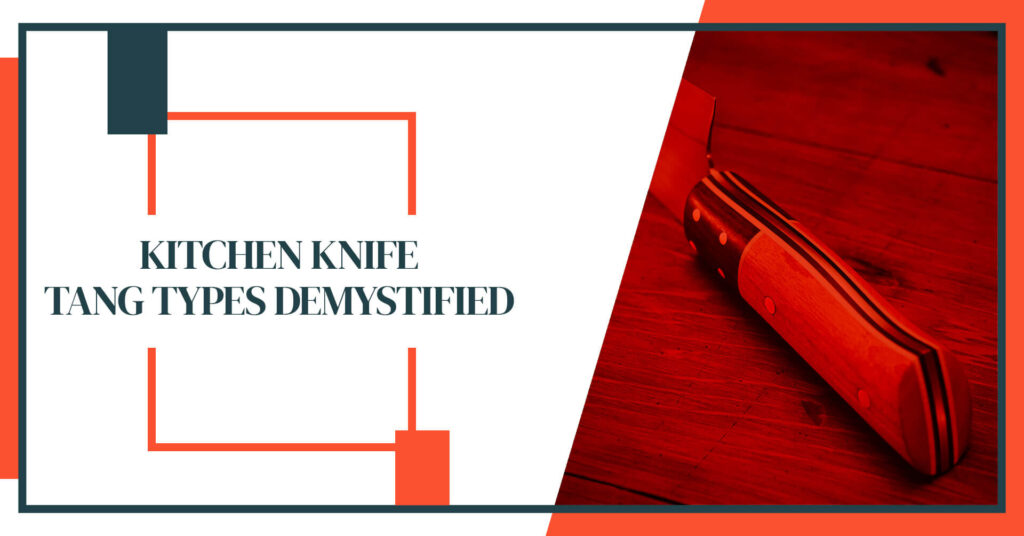
- Look at the spine where the blade meets the handle. A visible steel stripe sandwiched between two scales, with two or three rivets, means full tang. A seamless handle with no metal showing means hidden or partial — which, on a Japanese knife, is exactly what you want.
- Check the bolster. A big forged bolster with no visible spine behind it usually hides a partial or encapsulated tang. Not a red flag on its own — just information.
- Do the weight-in-hand test. Pinch the blade just ahead of the handle and let it pivot. Where it balances tells you more about how the knife will feel all night than any spec on the box.
- Match the tang to the job, not the price. Hard-use Western workhorse: want full tang. Delicate Japanese slicer: hidden tang is correct and normal. A quick-prep home knife: honestly, a solid partial tang is fine.
In a cheap $20 knife block set, the giveaway for a nasty rat-tail tang is weight and sound. Tap the handle butt on your palm — a hollow, rattly feel usually means a skinny stick tang swimming in molded plastic. It’ll still cut tomatoes for years. Just don’t pay full-tang money for it, and remember that a little knife care goes further than tang paranoia anyway.
HANDS-ON
On the Board: What Tang Actually Changes
Enough theory. Here’s what tang difference feels like in a real kitchen, from knives I actually own and use — the balance, the fatigue, the honest failures and non-failures.
[PHOTO-4: Balance-point demo — a chef’s knife balanced on one extended finger at the bolster, shot on Michael’s actual cutting board. ALT: Chef’s knife balancing on a finger at the bolster showing tang weight distribution]
My full-tang German chef’s knife balances right at the bolster — sit it on one finger there and it hangs level, dead neutral. My wa-handled gyuto balances a good inch and a half forward, out over the blade, so it always feels like it’s leaning into the cut for me. On a long Sunday prep session, the German knife is the one that tires my wrist first; all that handle steel adds up over a couple hundred slices. But it’s also the one I grab without thinking when I’m breaking down a squash, because it feels like it can take whatever I do to it. The gyuto is for when I want finesse. The German is for when I want to stop worrying.
I’ve owned a cheap partial-tang paring knife — one of those $8 jobs with the handle molded straight onto a stub of steel — for something like nine years. Everyone online told me it’d loosen and wobble and die. It hasn’t. The handle is exactly as tight as the day I bought it. It’s been through the dishwasher more times than I’d admit in front of a Japanese knife maker, and the tang never gave me a reason to think about it. Honest truth: for light in-hand work, the partial tang has been a total non-event. The knife’s dull half the time, sure — but that’s on me, not the tang.
When I’m actually standing in a shop deciding on a knife, the tang check takes me maybe ten seconds and I barely think about it anymore. I flip the knife spine-up and run my thumbnail along where the handle starts, feeling for that steel stripe and the rivets. Then I pinch the blade and let it teeter to find the balance point. That’s it. I’m not hunting for full tang — I’m checking that whatever tang it has matches what the knife is pretending to be. A “premium” Western chef knife hiding a rat-tail tang loses me instantly. A Japanese blade with a seamless wa handle gets no such penalty, because that’s the design working as intended.
The Final Cut
One last tip, and it’s the whole article in ten seconds: next time you’re holding a knife you might buy, flip it spine-up and read the tang before you read the price tag. Steel stripe and rivets down the handle? Full tang — good for a Western workhorse. Seamless handle, no metal showing? Partial or hidden — perfect for a Japanese slicer, fine for everyday work, and only a problem if the knife is charging you truck money for it.
Because that’s the real lesson here. Full tang isn’t “better,” the way a pickup isn’t “better” than a coupe. The truck is for the squash and the abuse; the sports car is for the slice. Once you can tell which chassis you’re holding — and match it to how you actually cook instead of what a survival forum panicked about — you stop paying for tang mythology and start buying the knife you need.
Now go cut something.
What the FAQ
What is the tang of a knife?
The tang is the part of the blade that extends past the sharpened edge into the handle. It’s the unsharpened piece of metal the knife handle is built around, anchoring the blade so the whole tool works as one unit. Every fixed-blade knife has one; the differences are all in its size and shape.
What does it mean when a knife has full tang?
Full tang means the blade steel continues at full width and length through the entire handle, with grip scales riveted to either side. You’ll see a stripe of steel down the spine and rivet heads in the handle. It’s the strongest, most balanced construction for Western knives — and the easiest tang design to identify at a glance.
Is a full tang knife stronger?
Under sideways stress, yes — a full tang resists prying and lateral force better than a partial or hidden tang. But for normal kitchen cutting, modern adhesives make a well-built partial tang plenty strong, and junction failures are rare. Full tang buys real durability you’ll mostly cash in only during hard, abusive use.
Are full tang knives better?
For Western-style and hard-use knives, full tang is a fair marker of quality and toughness. For Japanese knives, it’s close to meaningless — many of the best knives in the world use hidden tangs on purpose for a lighter, blade-forward feel. Better depends on the knife’s job, not on the tang alone.
Why do you put a penny on a knife?
Two different traditions. The common one is a gifting superstition: give a knife with a coin, and the receiver “pays” for it so the blade doesn’t cut the friendship. The other is practical — balancing a coin on the spine, or the knife on a finger, is an old way to find the balance point, which the tang largely controls.
What is a sword tang?
A sword tang is the same idea scaled up: the unsharpened portion of the blade that extends into the grip. On a katana it’s called the nakago, hidden inside the handle and held by bamboo pegs rather than rivets. Swords and daggers have used hidden tangs for centuries — proof that hidden doesn’t mean fragile.
Full tang or hidden — which do you need?
Now you can read a tang like the numbers on the box — want to know which knife those specs should live in? Try the 2-minute Knife Finder tool and get matched to the blade (full tang or not) that fits how you actually cook.