// Affiliate disclosure: some of the links in this post are affiliate links, which means we may earn a small commission if you buy through one, at no extra cost to you. And if you do, that money goes straight to our knife problem (or beer money, let's be honest).
The Short Answer
What Is a Gyuto Knife?
A gyuto (牛刀, "cow sword") is the Japanese version of the Western chef knife — a multi-purpose kitchen knife, usually 180–270mm, that runs thinner, lighter, and harder than its German cousin. Its flatter heel suits push-cutting, its curved tip suits rocking, and the thinner blade plus harder steel produce a keener edge that holds longer.
Key Takeaways
- What it is: the Japanese take on the chef knife — same all-purpose job, lighter build, harder steel, a sharper edge out of the box.
- Why it cuts better: a thinner blade plus harder Japanese steel means less wedging and better edge retention between sharpenings.
- The catch: that hard steel chips if you abuse it, and it wants a whetstone — a pull-through sharpener will wreck it.
- The verdict: for most home cooks stepping up from a starter knife, a 210mm gyuto is the single best upgrade there is — as long as you respect the stone and keep it off bones.
Somewhere along the way, “Japanese knife” got filed next to “delicate ceremonial object only a sushi master is allowed to touch.” Single bevel. Blessed by a monk. Costs more than your oven. You’ll ruin it by looking at it wrong.
A gyuto is none of that. It’s the workhorse of Japanese kitchens — a double-bevel, all-purpose blade that does exactly what your chef knife does, only lighter and sharper. Chefs in Tokyo dice onions with it all day, then sharpen it and do it again. If you own a chef knife, you already know how to use a gyuto. The only thing between you and one is hype that deserves puncturing. So let’s puncture it.
What Is a Gyuto Knife? Origin and Anatomy
The name is the best history lesson. Gyuto means roughly “cow sword,” dating to Japan’s Meiji era, when beef re-entered the Japanese diet after centuries off the menu. Cooks needed a blade for Western-style proteins, so they borrowed the shape of the European chef knife and rebuilt it the Japanese way — thinner, harder, keener.
📸 PHOTO 1 — REPLACE WITH IMAGE
Michael’s gyuto flat on a wood board next to a German 8-inch chef knife, blades parallel, shot from directly above so the profile difference (flatter gyuto heel, deeper German belly) and the thinner spine are both visible. Natural light, no props.
ALT: Gyuto knife next to a German chef knife on a cutting board, showing the gyuto’s flatter, thinner blade profile
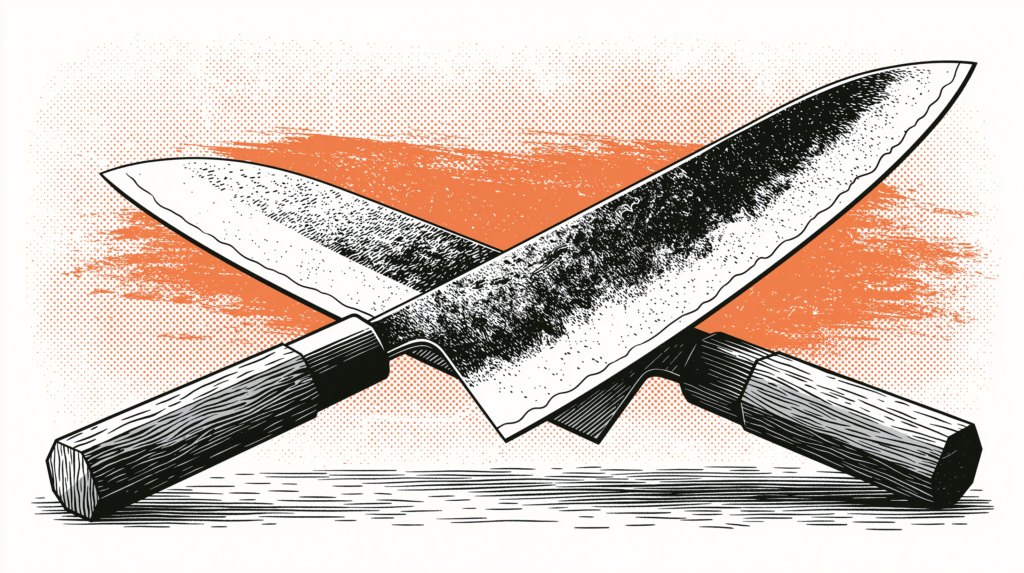
Put a gyuto next to a German 8-inch and the anatomy tells the story. The gyuto’s spine is thinner, so it wedges less through food. The profile is flatter toward the heel — the back third nearest the handle — which rewards push-cutting, then sweeps up to a fine, pointed tip that still lets you rock. Less curve, more flat. Subtle on paper, obvious in your hand. Where it really diverges from anything you’ve held is the handle.
A traditional Japanese wa handle is usually octagonal, light and unbolstered, shifting the balance forward toward the blade — great once you’re used to it, slightly alien at first. A Western yo handle is the riveted, contoured, heavier grip you already know from your chef knife. Neither is “better.” If you’ve only held a German knife and want zero learning curve, start with a yo handle.
What a Gyuto Is Actually For
Here’s the automotive way to think about it. A German chef knife is a diesel truck — heavy, forgiving, torquey, happy to be abused. A gyuto is a sports car — lighter, quicker, more precise, and the wrong vehicle for towing a trailer. Both get you down the road. You just don’t haul gravel with the Porsche.
Inside its lane, the gyuto is one of the most versatile knives in any kitchen — a true multi-purpose blade that’ll slice, chop, dice, and mince through nearly all your daily prep. Push-cut a pile of onions on the flat heel. Rock herbs on the curved tip. Ribbon cabbage, baton carrots, break down a chicken breast, cut a tomato thin enough to read through. The keener edge and thinner blade make those cutting techniques feel less like work — that versatility is the whole point of the design.
📸 PHOTO 2 — REPLACE WITH IMAGE
Mid-push-cut through an onion, Michael’s pinch grip clearly visible, thin slices accumulating — proves the knife is used, not staged. Slight side angle so the blade face and food contact both show.
ALT: Push-cutting an onion with a gyuto knife using a pinch grip
What it’s not for: bones, frozen food, and anything you’d split with a twist. Don’t hack a chicken carcass, don’t hack anything frozen, and don’t bury it in a butternut squash and lever — that thin, hard edge will chip, and it won’t chip politely. If the job needs brute force, put the gyuto down and grab the diesel truck. That one rule prevents most gyuto heartbreak.
The Harder Steel: What You Gain, What You Watch For
This is what actually separates a gyuto from your chef knife. Japanese steel runs harder. On the Rockwell scale — basically a number for how hard the steel is — a typical gyuto lands around 60–64 HRC, a German chef knife closer to 54–58. Harder steel takes a finer edge and holds it far longer. That’s the edge retention everyone raves about, and it’s real.
The honest trade-off nobody leads with: harder steel is more brittle. It chips instead of rolling when you mistreat it. A softer German edge bends and steels back; a hard gyuto edge, pushed too far, takes a tiny bite out of itself. Not a defect — physics, and the deal you sign.
The steel names on the box, translated:
- VG-10: the reliable stainless steel workhorse of mid-range gyutos. Sharp, good edge retention, rust-resistant, forgiving.
- SG2 / R2: a powder-metallurgy super steel, harder still, superb sharpness retention — but it asks more of you on the stones.
- High-carbon (non-stainless): takes possibly the keenest edge of all, but it rusts if left wet and develops a patina. Character, if you’re into that. Chores, if you’re not.
And that damascus pattern rippling down the blade? Damascus steel is usually just soft cladding folded around a hard core for looks — the damascus doesn’t make it sharper, the core does. Don’t pay for pretty thinking you bought sharpness.
| Gyuto | German chef knife | |
|---|---|---|
| Typical length | 180–270mm (210mm most popular) | 200–260mm (8 in standard) |
| Weight | Lighter, blade-forward | Heavier, handle-heavy |
| Steel hardness | ~60–64 HRC | ~54–58 HRC |
| Edge angle | Keener, ~15° or less per side | Wider, ~20° per side |
| Blade profile | Flatter heel, fine pointed tip | Deeper belly, more curve |
| Sharpening | Whetstone, no pull-through | Whetstone or a pull-through in a pinch |
A 60+ HRC gyuto and a pull-through sharpener are a bad marriage. Carbide pull-throughs tear steel away at a fixed, coarse angle — fine for a soft German blade, ruinous for a hard, finely-ground Japanese one. If you buy a gyuto, you’re signing up for a whetstone. Not optional. If you know for certain you’ll never learn one, buy a German knife and be happy.
Choosing the Right Gyuto: Size, Steel, and Handle
Three decisions, none worth agonizing over. Don’t overthink it.
Size. A 210mm gyuto is the default — long enough to break down a cabbage, short enough to feel nimble, the size most people should buy first. Go 180mm if your kitchen and cutting board are small; step up to 240mm if you cook big and want extra length for long slicing pulls. When in doubt: 210mm.
Steel. Stainless (VG-10 and friends) for low-drama ownership — that’s most home cooks, no shame in it. High-carbon if you’re chasing the keenest edge and don’t mind drying the blade every time. Both get scary sharp; one just forgives more.
Handle. Wa for lightness and blade-forward balance, yo for familiarity. Hold both if you can — your hand decides faster than any article.
📸 PHOTO 3 — REPLACE WITH IMAGE
Close-up of the handle/spine junction — the wa or yo handle Michael owns, with the choil and spine in focus, supporting the handle and anatomy passages.
ALT: Close-up of a gyuto knife handle and spine showing Japanese wa-handle construction
| What you're getting | Who it's for | |
|---|---|---|
| ~$40–80 (entry) | A real, functional stainless gyuto — decent steel, basic finish, genuinely sharp | Curious cooks testing whether the gyuto life is for them |
| ~$80–200 (sweet spot) | Better steel (VG-10, quality carbon), tighter grind, a blade you'll keep for years | Most people. This is where the value lives. |
| ~$200+ (diminishing returns) | Super steels, hand-finished fit, name-smith pedigree, damascus cladding | Enthusiasts paying for finish and pride, not a sharper cut |
Above roughly $200, you’re mostly buying finish, steel pedigree, and craftsmanship — not sharpness. A well-made $120 gyuto and a $400 one will both split a tomato skin under the knife’s own weight. Spend up because you want to, not because the cut gets better.
Buy a gyuto if: – You’ve outgrown a starter chef knife and want a real step up in sharpness and feel – You do a lot of produce and protein prep and want the daily driver to be a joy – You’re willing to learn a whetstone (easier than the internet makes it sound)
Skip it (for now) if: – You batter through bones, joints, and frozen food and won’t change that habit – You’ll never sharpen on a stone and want pull-through convenience – A $40 Victorinox already does everything you cook and you’re happy — genuinely, that’s a fine place to be
How to Care for a Gyuto
Get this wrong and the best blade in the drawer goes dull and sad. Keep it simple.
1. Hand wash and dry immediately. No dishwasher, ever — the heat and knocking around are bad for a hard edge, worse for carbon steel. 2. Use a soft board. Wood or soft plastic, always. Glass, stone, and marble are edge-killers — the fastest way home cooks murder a good gyuto. 3. Sharpen on a whetstone. A 1000-grit stone to sharpen, a 3000–6000 to refine. Never a pull-through. 4. Hone gently or not at all. A light ceramic rod is fine; a hard steel rod can micro-chip a hard Japanese edge. 5. Store it safe. A magnetic strip, blade guard, or knife stand — anywhere the edge isn’t clattering against other utensils in a drawer.
Is a Gyuto Worth It Over a German Chef Knife?
Time for the verdict, and I’m not going to fence-sit.
For most cooks who already have some knife skills and want to level up, yes — a gyuto is worth it, and it’s not close. The first time you feel a thin, hard, sharp blade fall through an onion instead of crunching through it, the German knife starts to feel like a butter knife in costume. The lightness saves your wrist over a long session, and a sharp knife goes where you point it.
But the German knife earns its keep too. It’s tougher, shrugs off the abuse that chips a gyuto, and forgives a pull-through sharpener and a lapse of attention. If your cooking involves hacking, prying, and the occasional bone — or if “learn a whetstone” makes you want to lie down — the German knife isn’t the compromise. It’s the right tool.
Gyuto wins on: – Sharpness out of the box and after sharpening – Lightness and agility — less wrist fatigue over long prep – Edge retention from harder steel – Precision on produce and proteins
German chef knife wins on: – Toughness — takes abuse a gyuto can’t – Forgiveness — survives pull-throughs and rough handling – Bones, hard squash, and heavy-duty jobs – Lower stakes if you’re rough on knives
A gyuto doesn’t cut better because it’s Japanese. It cuts better because it’s thinner and harder — and that same thinness and hardness is exactly why you can’t treat it like a truck.
HANDS-ON
On the Board
Specs tell you what a gyuto is. Living with one tells you whether it’s for you. Here’s the lived version, after months of a gyuto and a German 8-inch sharing the same block.
The difference shows up about halfway through a real mirepoix — three onions, four carrots, a head of celery. With the German knife my wrist starts rocking, that little metronome bounce off the belly, and by the last onion I feel it in my forearm. The gyuto changed my whole stroke without me deciding to. The flat heel wants to push straight down and forward, so I stopped rocking and started push-cutting, and the fatigue just isn’t there at the end. The German knife works your wrist; the gyuto works the board.
Mine stayed shaving-sharp for a good three to four weeks of near-daily cooking before it stopped catching arm hair, and even “dull” for a gyuto beats my German knife on its best day. The whetstone ritual takes about ten minutes on a 1000-grit and a few passes on a 6000 — genuinely calming once you stop being scared of it. And yes, I chipped it. Month two, a barely-thawed chunk of ginger I couldn’t be bothered to microwave. Tiny nick near the tip, entirely my fault, and it taught me more about board choice than any article could. The mistake is the tuition.
The honest reach test, both knives in the block: tomatoes for a salad, thin shallots, a pile of herbs, breaking down chicken breasts — my hand goes for the gyuto every time now, no thought involved. But the second there’s a bone, a winter squash, or I’m splitting a carcass for stock, I’ve got the German knife before my brain’s caught up. That split is the whole answer to “which one.” The gyuto won the daily prep; the German knife still owns the rough stuff, and I’d tell you to end up owning both.
The Final Cut
Strip away the mystique and a gyuto is simple: it’s your chef knife, rebuilt thinner and harder by people who obsess over steel. Sharper because it’s ground finer, holds its edge because the steel is harder, chips if you treat it like a crowbar — all the same coin.
If you’ve got some knife skills and you’ll keep it off bones and learn a stone, this is the knife I’d point you at first. A 210mm stainless gyuto in the $80–200 range is the blade I reach for every day, and the one I’d hand a friend ready to feel what a properly sharp knife does. Keep the German knife in the block for the rough stuff and let the gyuto do the daily cooking. That split has worked in my kitchen for years, and I think it’ll work in yours.
Now go cut something.
What the FAQ
What do you use a gyuto knife for?
Nearly all your daily prep — slicing, chopping, dicing, and mincing produce and boneless proteins. Push-cut vegetables on the flat heel, rock herbs on the tip, ribbon cabbage, break down a chicken breast. It’s a true multi-purpose knife. Just keep it off bones, frozen food, and hard squash.
What’s the difference between a gyuto and a santoku?
Both are Japanese all-rounders, but the gyuto is longer with a pointed tip and some curve for rocking, while a santoku is shorter, flatter, and blunter-nosed, built for straight up-and-down chopping. A gyuto slices and does tip work better; a santoku knife feels nimble in a small kitchen. We break down gyuto vs santoku, compared properly if you’re torn.
What is the difference between a chef knife and a gyuto?
A gyuto is the Japanese chef knife — same all-purpose role, different build. It’s thinner, lighter, and made from harder steel (~60–64 HRC vs ~54–58), with a flatter profile and a keener edge. It cuts more precisely and holds sharp longer, but it’s less tough. Here’s how a gyuto stacks up against a Western chef knife in full.
How much does a gyuto knife cost?
Real ones start around $40–80 for a functional stainless entry blade. The sweet spot is $80–200, where better steel and grind get you a knife for life. Above $200 you’re mostly paying for finish, damascus cladding, and smith pedigree — not extra sharpness.
Which is better, a gyuto or a santoku?
For most cooks who want one do-everything knife, the gyuto — the extra length and pointed tip make it more versatile. The santoku wins if you have a small kitchen, small hands, or find long blades intimidating.
Do I need a santoku if I have a gyuto?
Honestly, no — they overlap heavily, and a 210mm gyuto covers everything a santoku does and then some. A santoku is a nice-to-have for a second cook or lighter chopping, not a must-buy. Full breakdown in gyuto vs santoku.
What three knives should every cook have?
A chef knife (or a gyuto), a serrated bread knife, and a small paring knife. That trio handles essentially every home-cooking task — plus what a petty knife is for if you want the nimble in-between.
Is a gyuto a chef knife?
Yes — it’s the Japanese version of one. Same all-purpose job as the Western chef knife, just thinner, harder, and sharper. If you’re deciding between a gyuto and something like a kiritsuke, gyuto vs kiritsuke sorts out which pointed Japanese blade suits you, and our plain-English chef knife explainer covers the Western side.
Is a Gyuto Right for Your Kitchen?
So a gyuto sounds tempting — but is it actually the right first Japanese knife for how you cook? Try the 60-second Knife Finder tool and get matched to the blade you’ll actually reach for.